
Saudi visa for U.S. citizens: which one, where to apply, and fees
Saudi visas are electronic. The Foreign Ministry’s e-services page lists separate visas for tourism, Umrah, Hajj, family and personal visits, business, medical treatment, residence, study and work, and each links to its own service page.
For an American, the visas go through two portals: Visit Saudi’s eVisa portal for tourism, and the ministry’s KSA Visa platform for the rest. Hajj is the exception: it goes through Nusuk Hajj.
Which Saudi visa fits your trip
The fee column comes from each visa’s service page on the ministry’s site. The ministry quotes Saudi riyals (SAR).
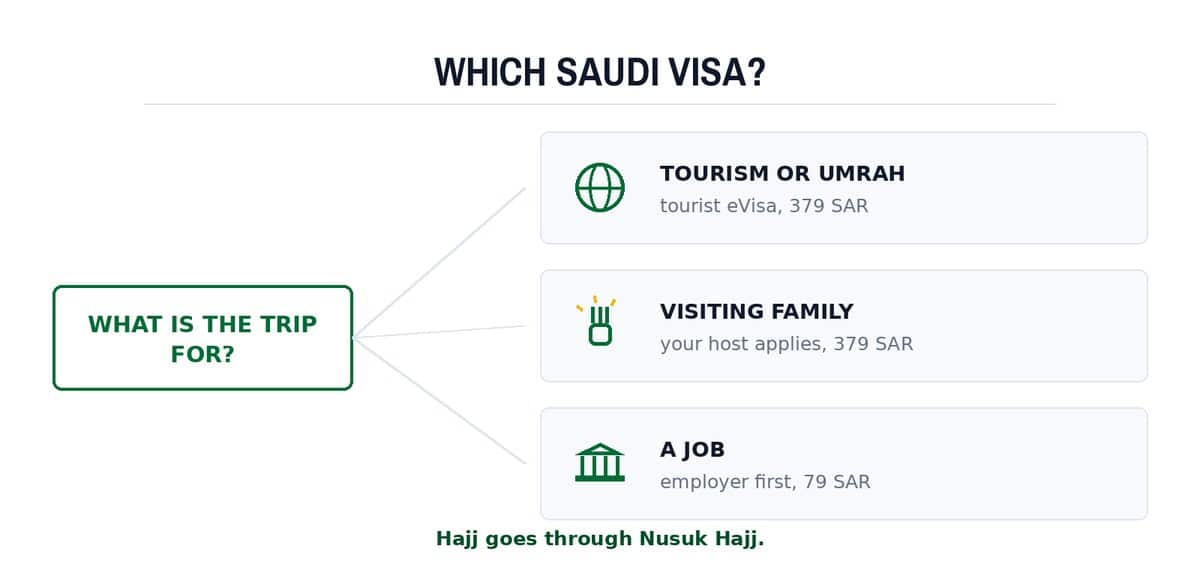
| Your trip | Visa and fee | Who applies |
|---|---|---|
| Tourism, events, seeing friends or family | Tourist visa, 379 SAR | You, online |
| Umrah | Umrah visa, 300 SAR, or the tourist eVisa | You, online, then a permit in Nusuk |
| Hajj | Hajj visa, free | Through Nusuk Hajj and a provider |
| Visiting a relative who lives there | Family visit visa, 379 SAR | Your host in Saudi Arabia |
| Business meetings | Business visit visa, 379 SAR | You, with an invitation |
| Medical treatment | Medical visa, 379 SAR | You, with a confirmed appointment |
| A job in Saudi Arabia | Work visa, 79 SAR | Your employer first |
The tourist visa page runs every step online, from choosing the purpose of travel to printing the visa, and gives the service time as immediate (tourist visa page). Our eVisa guide goes through it.
New procedure guides, by email
We’ll email you when we publish a new procedure guide. No ads, and you can unsubscribe at any time.
How long you can stay
Visit Saudi describes the eVisa as a one-year, multiple-entry visa with stays of up to 90 days. The State Department adds that tourist visa holders are generally admitted for 90 days and may not remain more than 180 days in a twelve-month period (its Saudi Arabia page).
It also warns that dates are counted on the Hijri calendar, which differs from the Gregorian one, and that overstaying can bring fines, detention, deportation and a ban on returning.
When a consulate comes into it
For tourism, Umrah and visits arranged by a host, the ministry’s pages describe an online process with no consulate step. Two visa pages add one at the end: for a medical or a residence visa, the visitor completes the embassy or consulate procedures after approval (medical visa page, residence visa page).
The work visa page lists a medical examination and biometric fingerprinting among its steps, without saying where they take place in the U.S. (work visa page). See work and business visas.
- A valid passport
- A personal photo
- Proof of accommodation, for the tourist visa
- Your host’s Saudi ID or residency number, for a family or personal visit
- A way to pay the fee online
Visas for study and other purposes
The ministry’s list also has short-term and long-term educational visas, for language study, training, exchanges, academic study and research, and an escort visa for people accompanying a visa holder or a Saudi or GCC citizen. Each has its own page on the e-services list.
A tourist eVisa involves no consulate visit: the ministry’s tourist visa page runs every step online, up to printing the visa.