
Umrah visa from the USA: tourist eVisa or Umrah visa
Pilgrims from the United States do not go through a consulate for the Umrah.
The eVisa and the Umrah visa are both requested online, and the Foreign Ministry gives the Umrah visa an immediate service time on its Umrah visa page. The transit visa appears on the U.S.
Embassy’s Hajj and Umrah page, which does not describe how to get it.
Which route suits you depends on the trip. The eVisa is a one-year, multiple-entry tourist visa that Visit Saudi says can be used for the Umrah and for tourism. The Umrah visa is a dedicated visa whose page asks for a licensed entity or an accredited platform.
Tourist eVisa or Umrah visa
| Tourist eVisa | Umrah visa | |
|---|---|---|
| Fee on the ministry’s page | 379 SAR | 300 SAR |
| Where you apply | Visit Saudi or KSA Visa | KSA Visa |
| Also valid for | Tourism, events, family visits | The Umrah |
| Not valid for | The Hajj and studying | Not stated on the page |
| Permit step | Not described on its page | Umrah permit in Nusuk |
The «not valid for» row on the eVisa side comes from Visit Saudi’s description: tourism-related activities including the Umrah, excluding the Hajj, and excluding activities such as studying.
New procedure guides, by email
We’ll email you when we publish a new procedure guide. No ads, and you can unsubscribe at any time.
Applying for the Umrah visa step by step
The ministry lists the steps in this order: open KSA Visa and choose the Umrah visa, create an account or log in, enter your personal and passport details, then your travel and accommodation information.
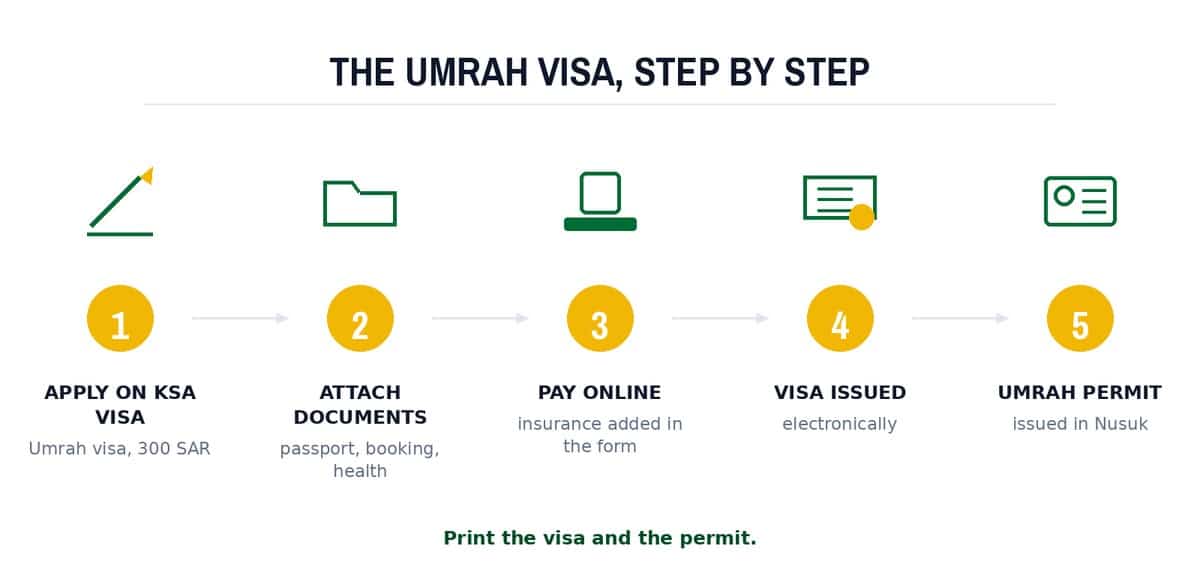
Next you attach the documents, issue or add the medical insurance, review the request and pay. Once the visa is issued, you issue the Umrah permit through the Nusuk platform, print the visa and the permit, and travel within the visa’s validity.
- A valid passport
- Proof of booking or contracting
- Health certificates and a personal photo
- Medical insurance, issued or added during the application
- The fee, 300 SAR, paid online
The conditions on the ministry’s page
The request must go through a licensed entity or an accredited platform, health requirements and the accredited conditions must be met, and the fee must be paid. The page does not publish a list of those entities; Nusuk is where the ministry sends you for the permit.
If you are planning the Hajj rather than the Umrah, the route is different and the eVisa does not cover it: see Hajj from the U.S.
Before you book flights
If you go on the tourist eVisa, its limits are the tourist ones: up to 90 days per visit according to Visit Saudi, and no more than 180 days in twelve months according to the State Department, which also counts dates on the Hijri calendar (Saudi Arabia page).
On the Umrah visa, the medical insurance is part of the application itself: the ministry’s steps have you issue it or add it before you review and pay. Travel within the visa’s validity period, which is the last step on the page.
The ministry also lists an Umrah courtesy visa, issued for Saudi missions abroad and granting entities. It is not an application route for the public: the page describes it as a service for the missions and those entities (e-services list).
On the Umrah visa, the permit is a separate step in Nusuk after the visa: print both before you fly.